 The Nexus Archive
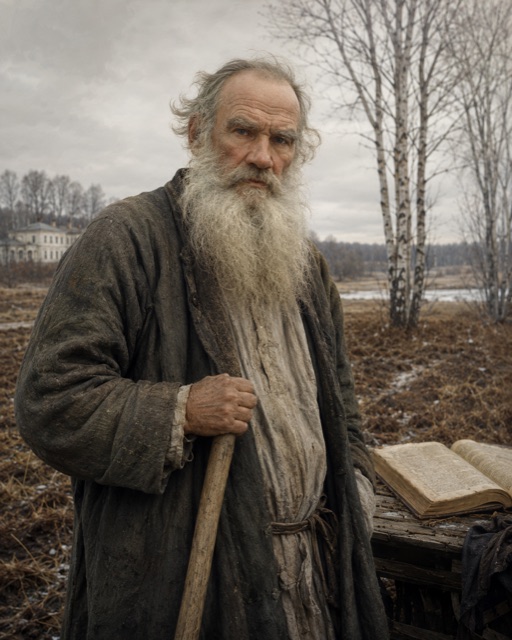
Moral Realism · Memoir
A Confession
by Tolstoy · The Searcher of Conscience · Russian Realism, 1828-1910
Tolstoy recounts a crisis of meaning that fame, family, reason, and social success could not resolve.
- Advanced
- ~2 hr read
- 2 chapter guides
- Public domain
Start reading · Read the Chapter VI guide free
Before the text
Editor's Prelude
When Success Became a Death Sentence
In middle age, with literary fame, property, and family, Tolstoy found ordinary life emptied of justification. The question was not abstract: if death cancels every achievement, why continue living at all?
A Confession follows failed answers through science, philosophy, pleasure, and the lives of Tolstoy's social class before turning toward the faith of working people. That turn is searching, grateful, and still unsettled.
Tolstoy’s images of lost roads, drifting boats and vanishing ground make the search itself a matter of survival. It records a person testing whether life can be supported when reason cannot supply the ground it demands.
The opening pages
Chapter I
A CONFESSION
AN INTRODUCTION TO A CRITICISM OF DOGMATIC THEOLOGY AND AN EXAMINATION OF THE CHRISTIAN TEACHING.
I
I was baptized and brought up in the Orthodox Christian faith. I was taught it in childhood and throughout my boyhood and youth. But when I left the second course of the university, at the age of eighteen, I no longer believed any of the things I had been taught.
Judging by certain memories, I never seriously believed, but merely relied on what I was taught and on what was professed by the grown-up people around me; and that reliance was very unstable.
I remember that before I was eleven, a boy, Vladimir Milyutin (long since dead), a grammar school pupil, visited us one Sunday and announced as the latest novelty a discovery made at his school. The discovery was that there is no God, and that all we are taught about Him is a mere invention (this was in 1838). I remember how interested my elder brothers were in this news. They called me to their council, and we all, I remember, became very animated, and accepted the news as something very interesting and quite possible.
I remember also that when my elder brother, Dmitry, who was then at the university, suddenly, in the passionate way natural to him, devoted himself to religion and began to attend all the Church services, to fast and to lead a pure and moral life, we all—even our elders—unceasingly held him up to ridicule and called him, for some unknown reason, ‘Noah.’ I remember that Musin-Pushkin, the then curator of Kazan University, when inviting us to a dance at his house, ironically persuaded my brother (who was declining the invitation) by the argument that even David danced before the Ark. I sympathized with these jokes made by my elders, and drew from them the conclusion that though it is necessary to learn the catechism and go to church, one must not take such things too seriously. I remember also that I read Voltaire when I was very young, and that his raillery, far from shocking me, amused me very much.
My lapse from faith occurred as is usual among people on our level of education. In most cases, I think, it happens thus: a man lives like everybody else, on the basis of principles not merely having nothing in common with religious doctrine, but generally opposed to it; religious doctrine does not play a part in life, in intercourse with others it is never encountered, and in a man’s own life he never has to reckon with it. Religious doctrine is professed far away from life and independently of it. If it is encountered, it is only as an external phenomenon disconnected from life.
Chapter guides · 2
Chapter VI
Success Cannot Answer Death
Tolstoy has family, property and literary fame, yet cannot explain why any of them should matter in the face of death. His search through human knowledge deepens the despair it was meant to relieve.
The beliefs that had sustained him
Tolstoy traces his loss of Orthodox belief and the ambitions that took its place. The desire to become better gave way to wanting wealth, fame and superiority. He recalls accepting the writers' claim to teach humanity, then recognizing their quarrels and his own ignorance of what to teach. An execution in Paris and his brother's painful death shook his belief in progress. School work left the teaching problem unresolved; marriage then absorbed him in providing for his family.
A question his achievements cannot settle
The question of what his efforts lead to returns until ordinary life becomes impossible to justify. Though outwardly fortunate, he struggles against an impulse to end his life. Experimental knowledge, he argues, explains processes without answering why he should live; abstract inquiry reaches the question without supplying a sustaining answer. In the passages he presents from Socrates, Schopenhauer, Ecclesiastes and the story of Buddha, he finds confirmation of his despair. He ends by echoing the verdict that death is better than life.
Chapter XI
Beyond His Own Circle
Tolstoy questions whether the life of the rich and learned can stand for human life as a whole. Among working believers, he finds a meaning sustained in conduct, and turns his accusation of life back upon his own way of living.
Questions readers ask
- How long does it take to read A Confession?
- About 2 hr in total.
- How difficult is A Confession?
- Advanced. A mid-length memoir; about 2 hours of reading.
- Which translation is this?
- The Aylmer Maude translation from the Russian, first published in 1884. The text follows A Confession and What I Believe, translated, with an introduction, by Aylmer Maude (The World's Classics, no. 229; London: Humphrey Milford, Oxford University Press, 1921).
- Can I read A Confession for free?
- A Confession is part of Nexus Premium, so reading it needs an account and a Premium subscription. The opening above and one chapter guide on this page are free to read.
- How many chapter guides are there?
- 2 chapter guides, written by the Nexus editors. One opens in full here; the rest show their opening line.
About Tolstoy
Leo Tolstoy was a Russian novelist, moral thinker, and social critic whose major works brought family life, history, death, violence, faith, and moral awakening into vast narrative form. His later spiritual crisis reshaped his public life and gave his fiction an even sharper judgment on vanity and false living.
“What does a life become when it can no longer hide from truth?”
Tolstoy gives Nexus the widest moral canvas in fiction: private homes, public history, illness, war, faith, and the exact moment when a person sees life differently.
Source text: public domain. Chapter guides: original Nexus writing. A Confession is part of The Nexus Archive, guided Quests through the great works.