 The Nexus Archive
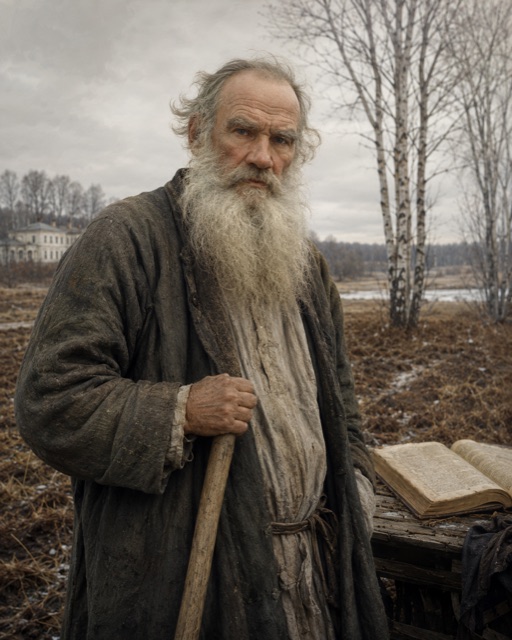
Moral Realism · Novel
The Kreutzer Sonata
by Tolstoy · The Searcher of Conscience · Russian Realism, 1828-1910
A train confession turns marriage, jealousy, sexuality, music, and murder into an unstable moral indictment.
- Advanced
- ~2 hr 30 min read
- 2 chapter guides
- Public domain
Start reading · Read the Chapter IX guide free
Before the text
Editor's Prelude
A Murderer Explains Himself
A conversation about marriage on a train prompts Posdnicheff to reveal that he killed his wife. The novella unfolds as his account to a fellow passenger. An ordinary railway journey becomes an encounter with a man who wants to explain both his crime and the world that, he believes, made it possible.
Posdnicheff attacks sexual custom, marriage, medicine and music. He condemns men for treating women as possessions, yet speaks of women with mounting fear and hatred. The force of his arguments comes with the pressure of his voice: he interrupts, repeats himself and turns remembered details into sweeping judgments.
Tolstoy places that voice inside another traveler's account. The listener questions him and notices the strain in his face and movements. Confession and accusation keep crossing. The stakes lie in whether a man can recognize another person's suffering while remaining so absorbed in his own.
The opening pages
Fourth-edition title and copyright leaves
The Kreutzer Sonata
by
Count Leo Tolstoï
translated by
Benj. R. Tucker
FOURTH EDITION.
Boston, Mass.
Benj. R. Tucker, Publisher
1890
Copyright, 1890,
By Benj. R. Tucker.
Chapter I
THE KREUTZER SONATA.
I.
Travellers left and entered our car at every stopping of the train. Three persons, however, remained, bound, like myself, for the farthest station: a lady, neither young nor pretty, smoking cigarettes, with a thin face, a cap on her head, and wearing a semi-masculine outer garment; then her companion, a very loquacious gentleman of about forty years, with baggage entirely new and arranged in an orderly manner; then a gentleman who held himself entirely aloof, short in stature, very nervous, of uncertain age, with bright eyes, not pronounced in color, but extremely attractive,—eyes that darted with rapidity from one object to another. This gentleman, during almost all the journey thus far, had entered into conversation with no fellow-traveller, as if he carefully avoided all acquaintance. When spoken to, he answered curtly and decisively, and began to look out of the car window obstinately.
Yet it seemed to me that the solitude weighed upon him. He seemed to perceive that I understood this, and when our eyes met, as happened frequently, since we were sitting almost opposite each other, he turned away his head, and avoided conversation with me as much as with the others. At nightfall, during a stop at a large station, the gentleman with the fine baggage—a lawyer, as I have since learned—got out with his companion to drink some tea at the restaurant. During their absence several new travellers entered the car, among whom was a tall old man, shaven and wrinkled, evidently a merchant, wearing a large heavily-lined cloak and a big cap. This merchant sat down opposite the empty seats of the lawyer and his companion, and straightway entered into conversation with a young man who seemed like an employee in some commercial house, and who had likewise just boarded the train. At first the clerk had remarked that the seat opposite was occupied, and the old man had answered that he should get out at the first station. Thus their conversation started.
I was sitting not far from these two travellers, and, as the train was not in motion, I could catch bits of their conversation when others were not talking.
They talked first of the prices of goods and the condition of business; they referred to a person whom they both knew; then they plunged into the fair at Nijni Novgorod. The clerk boasted of knowing people who were leading a gay life there, but the old man did not allow him to continue, and, interrupting him, began to describe the festivities of the previous year at Kounavino, in which he had taken part. He was evidently proud of these recollections, and, probably thinking that this would detract nothing from the gravity which his face and manners expressed, he related with pride how, when drunk, he had fired, at Kounavino, such a broadside that he could describe it only in the other's ear.
Chapter guides · 2
Chapter IX
Power, Desire and Fear
Posdnicheff argues that women use sexual attraction to gain power because men deny them equal freedom. His attack on inequality ends in fear of richly dressed women.
A right to choose
The narrator questions how women can rule men when they have fewer rights. Posdnicheff says the chief injustice is their lack of equal freedom to choose a partner or refuse sex. He argues that women answer this dependence by using men's desire to control them.
Luxury as a weapon
He points to city shops that sell almost nothing for men and to factories making women's ornaments. In his view, vast numbers of workers labor to satisfy women's wishes. He treats this supposed power as revenge for the way men have reduced women to objects of desire.
Attraction becomes a threat
His argument ends in alarm. He says a richly dressed woman frightens him so much that he wants police protection. He compares clothing that arouses desire to traps set in public streets.
Chapter XVIII
Distraction and Renewed Fear
City life makes the couple less aware of their unhappiness. When his wife stops having children, Posdnicheff treats her renewed beauty as a danger.
Questions readers ask
- How long does it take to read The Kreutzer Sonata?
- About 2 hr 30 min in total.
- How difficult is The Kreutzer Sonata?
- Advanced. A mid-length novel; about 2 hours of reading.
- Which translation is this?
- The Benjamin R. Tucker translation from the Russian, first published in 1889. The text follows The Kreutzer Sonata, translated by Benj. R. Tucker, fourth edition (Boston: Benj. R. Tucker, 1890).
- Can I read The Kreutzer Sonata for free?
- The Kreutzer Sonata is part of Nexus Premium, so reading it needs an account and a Premium subscription. The opening above and one chapter guide on this page are free to read.
- How many chapter guides are there?
- 2 chapter guides, written by the Nexus editors. One opens in full here; the rest show their opening line.
About Tolstoy
Leo Tolstoy was a Russian novelist, moral thinker, and social critic whose major works brought family life, history, death, violence, faith, and moral awakening into vast narrative form. His later spiritual crisis reshaped his public life and gave his fiction an even sharper judgment on vanity and false living.
“What does a life become when it can no longer hide from truth?”
Tolstoy gives Nexus the widest moral canvas in fiction: private homes, public history, illness, war, faith, and the exact moment when a person sees life differently.
Source text: public domain. Chapter guides: original Nexus writing. The Kreutzer Sonata is part of The Nexus Archive, guided Quests through the great works.